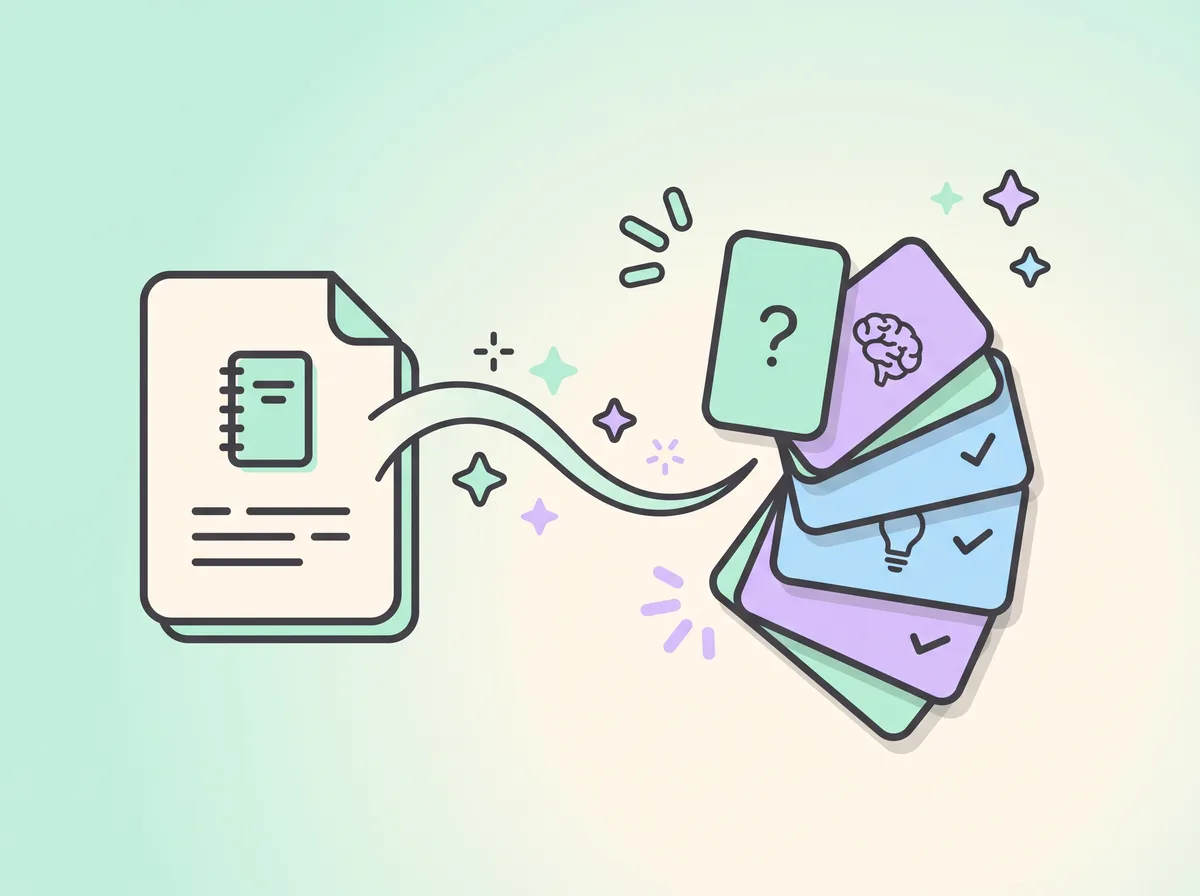
Mindlet turns any course into flashcards, quizzes, study guides and practice exams. Reading adjusts to the way you read, every card links back to the passage it came from, and you review right when you were about to forget.
Designed by a dyslexic co-founder: adapted fonts, syllable splitting, silent letters, a reading ruler, correction for seven types of colour blindness. Everyone turns on what they need.
Every generated card links back to the passage of your course it came from, with the page when the document has one. A doubtful card can be reported, and the fix rereads your course.
Designed by a dyslexic, for everyone who learns differently.
Anthony MenghiCo-founder of Mindlet
Anthony is dyslexic, and both his brothers have multiple dys conditions. Mindlet's reading settings come from there: they were designed before the rest, not bolted on at the end.
Six profiles (Dyslexie, Concentration, Fatigue oculaire, Basse vision, Sensoriel, Standard) and a reading comfort test to find yours, without ever asking whether you are dyslexic. Nothing is imposed: everyone turns on what helps them.
OpenDyslexic, Lexend, Atkinson or Nunito fonts, adjustable spacing
Syllable splitting, silent letters, 14 French sounds in colour (French text)
Reading ruler, highlighted current line, dimmed paragraphs
Colour correction for seven types of colour blindness
The water cycle describes how water travels around the Earth. The Sun heats the oceans: water evaporates, rises and forms clouds.
In the mountains, rain and snow feed the rivers, which carry water back to the Mediterranean Sea or the Atlantic Ocean. About 97% of the planet's water is found in the oceans.
When this movement passes through plants, it is called evapotranspiration. Water never disappears: it changes state, from liquid to vapour and back again.
Syllable splitting, silent letters and phoneme colours only work on French text, as in the app. Try them on this French sentence:
Turn on a profile (Dyslexie, Concentration) or an aid such as the reading ruler in the panel: this block changes straight away. The panel on this site is in French, like the app, and offers part of the app's settings, sometimes with different ranges.
Traceable AI
Every card knows where it came from.
During a review, “Voir le passage” opens the exact excerpt of your course that was used to write it, with its page when the document has one.
In your collection, “Pourquoi cette carte ?” explains what it checks. And if a card looks wrong, report it: the fix rereads the passages of your course. If the course doesn't settle it, nothing is changed.
Cards are drawn from your course, not from general knowledge
The source document opens without leaving the review
Les passages et sources qui ont servi à préparer cette carte.
Voir le document source
Passages du document
cell-biology-chapter-3.pdfPage 12
The mitochondrion is an organelle surrounded by a double membrane. It produces most of the cell's energy, in the form of ATP, through cellular respiration.
Lire la page 12
The shape of knowledge
Your course, organised into notions.
Mindlet finds the notions in your course, groups them into sub-topics and topics, and notes which ones depend on others.
So you learn in order: a lesson path, prerequisites unlocked at the right time, and mastery tracked notion by notion rather than a plain card counter.
Topics, sub-topics and notions drawn from your documents
A mind map of the collection, to generate cards from
For a teacher: the notions the class struggles with
A YouTube link or a video file. Mindlet transcribes it, spots the key moments and turns them into cards.
Audio and recorded lectures
A lecture recording, a podcast, a talk: up to four hours of listening.
Web pages and sites
One page, or a whole site up to fifty pages. Handy for documentation or an online course.
Also: photos of notes, pasted text, Anki decks, and even a plain topic when you don't have a course yet.
How it works
Three steps, and you're reviewing.
1
Drop your course
A file, a link or some text. You can add more to the same collection later.
2
Mindlet prepares
The AI finds the key notions, groups them into topics and writes cards in several formats, with a lesson path.
3
You review at the right time
Each day, Mindlet shows you the cards you are about to forget. No more, no less.
Formats
One notion, learned several ways.
Mindlet does more than flashcards. For each notion it picks the formats that fit: a multiple-choice question for a date, an ordering card for a process, a map card for a country, an open question graded by AI to check you can explain it.
Fiche de révisionCarte mentalePodcastDiaporamaVidéo
The method
Review just before you forget.
A lesson fades within days if you don't revisit it. Each review placed at the right moment lifts it back up, and the next drop is slower. That's spaced repetition, one of the best-supported learning methods in research.
Mindlet works out that moment for every card, and adjusts its settings every week to your own forgetting rhythm.
Pick the format (multiple choice, written or mixed) and the length. Mindlet builds a paper from your course, times it, grades it out of 20 and tells you, topic by topic, what still needs work.
No corrections during the exam, just like on the day
Written answers graded by AI, with written feedback
The assistant knows your collections. It explains a notion another way, quizzes you, creates cards for you, and can even talk to you out loud (in French).
I don't get the difference between mitosis and meiosis.Mitosis makes two identical cells. Meiosis makes four different ones, with half the chromosomes. Want three questions to check?Yes, go.
The free plan gives you 400 éclats a month to import and generate, and reviewing never costs anything, whatever your plan. Paid plans give you more éclats, from €4.99 a month on the web billed yearly (€5.99 with no commitment).
For a middle school, high school, university or training body: we equip a group, train the team on site, measure, and hand you a report, even if it isn't flattering. No commercial strings attached.
On three points. Reading can be adjusted for dyslexia, ADHD or eye strain, with aids designed by a dyslexic co-founder. Every generated card links back to the passage of the course it came from. And the course is organised into topics, notions and prerequisites, so you learn in order. The app-by-app detail is in our comparisons.
Is Mindlet suitable for people with dyslexia or ADHD?
Yes, it's one of the reasons Mindlet exists. In the accessibility settings, six profiles and a reading comfort test offer adapted fonts, syllable splitting (French text), silent letters, a reading ruler or dimmed paragraphs. These aids are offered, never imposed. See the dedicated page.
Is Mindlet free?
Yes, there is a free plan with no time limit and no credit card: three collections, a hundred cards and 400 éclats a month (éclats are the unit for AI work). Paid plans (from €4.99 a month on the web billed yearly, €5.99 with no commitment) give you more éclats and raise the limits. Reviewing never costs anything. Details on the pricing page.
Is the app available in English?
The Mindlet app interface is in French for now. Your courses, cards and study guides can be in English: content can be generated in nine languages, including English, Spanish and German.
Which files can I import?
PDFs (even scanned), Word, PowerPoint, Excel, ePub, OpenDocument, images, audio and video files up to four hours, YouTube links, web pages or sites, pasted text and Anki decks. iPhone HEIC photos aren't supported yet.
Are AI-generated cards reliable?
They are drawn from your course, not made up, but an AI can make mistakes. You can edit or delete every card. For classroom use, we ask that an adult reviews what is shared with the group.
What is spaced repetition?
It's a method where you revisit a notion at growing intervals, just before you would forget it. Mindlet computes that moment for each card with the FSRS algorithm and adjusts it weekly to your rhythm. More on the dedicated page.
Which AI does Mindlet use?
Mainly models from Mistral AI, a French company, for card generation, the assistant, document reading and voice. The full list of providers is on our AI page.