About Mindlet
Why Mindlet exists
Mindlet started at the Università di Corsica, in Corte. Two co-founders, one of them dyslexic, started from an observation: studying took too much manual work, and almost nothing was designed for people who read or focus differently.

 Fattu in Corsica Live since 14 June 2026
Recognised and supported by
-
 Prix Pépite France winner, 2025
-
 Top 30 Tech for Change, VivaTech 2026
-
 Start'in Corsica winner, 2025
-
 Pre-incubated at Inizià, the Corsican incubator
Our mission
Make learning accessible, interactive and inclusive, from middle school to continuing education.
Where Mindlet comes from
A student project, then a company.
It wasn't an ambitious project at first: the idea took shape while talking with friends who were studying with flashcard apps.
- The start
Corte
A student project at the Università di Corsica
Those conversations made one thing clear: preparing your revision takes time you then lack for actually learning, and existing tools don't adapt to the way each person reads.
- The compass
One of us is dyslexic
That constraint shaped the whole product. If learning adapts to the way you think, it also has to adapt to the way you read, the way you get tired and the way you remember.
- 2025
Prix Pépite France and Start'in Corsica winner
The project was incubated at PEPITE Corse, at the Università di Corsica, and won two awards in the same year.
- 2026
Web, iPhone, Android
The first version goes live
On 14 June 2026, Mindlet launched on the web, the App Store and Google Play. The same year, it was named in VivaTech's Top 30 Tech for Change.
The team
Two co-founders, one Corsican company.
Mindlet is published by SAS MINDLET, registered with the Bastia trade and companies register.
-
Mehdi Ghoulam
President, co-founder
President of SAS MINDLET and publication director of this website.
-
Anthony Menghi
Managing director, co-founder
Dyslexic, like his two brothers, who have multiple dys conditions. Mindlet's reading settings come from there.
Inclusion
Built for dyslexic learners from day one.
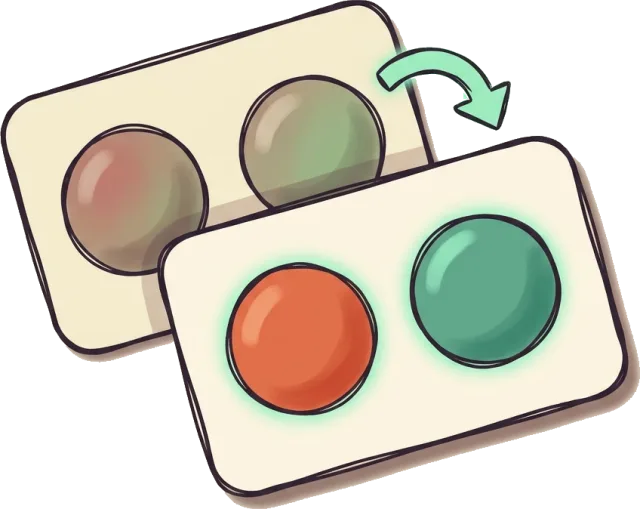
The reading settings were not bolted on at the end. They include OpenDyslexic, Lexend and Atkinson fonts, spacing, syllable splitting, silent letters, a reading ruler and colour correction for seven types of colour blindness.
Everyone turns on what they need, nothing is imposed. The reading comfort test compares fonts under neutral names and never asks whether you are dyslexic.
- Six presets: Standard, Dyslexia, Focus, Eye strain, Low vision, Sensory
- Syllable splitting and colour coding of 14 phonemes, for French text
- OpenDyslexic is offered, never imposed: its benefit to reading speed hasn't been shown (Wery and Diliberto, 2017; Kuster, 2018)

Our choices
Science, accessibility, European AI.
These stances explain most of our decisions. One rule ties them together: say exactly what we do.
-
The science of memory
Mindlet schedules reviews with spaced repetition, one of the best-supported learning methods (Cepeda et al., 2006, Psychological Bulletin). The schedule adjusts every week to your own forgetting rhythm.
Learn more -
Honest accessibility
Our statement says "non-compliant" with the French RGAA framework, because no audit has been carried out yet. We'd rather publish an honest page than a reassuring one.
Learn more -
Mistral AI at the core
Cards, the assistant, document reading and voice run on models from Mistral AI, a French company. Every provider is listed in our legal notice.
Learn more -
Your courses stay yours
We do not use your content to train artificial intelligence models. It's written in our terms.
Learn more
What we refuse
What we won't do.
- Put advertising in the app, or sell data.
- Use your content to train artificial intelligence models.
- Award a certifying grade or a diagnosis. A practice exam graded out of 20 is for practice, it certifies nothing.
- Impose an accessibility profile, or ask anyone whether they are dyslexic.
- Market to the learners or families of a pilot school.
- Write "100% sovereign": we list every provider, its role and its country instead.
Corsica
Fattu in Corsica, for everyone who learns.
Mindlet was born in Corte, the island's university town. The company is headquartered in Aléria, on the east coast.
The project was incubated at PEPITE Corse, at the Università di Corsica, and won Start'in Corsica in 2025.
Partners and press
Schools, journalists, partners.
For an article, a partnership or a school that wants to try Mindlet with a class, write to us. Schools can also join the pilot program, which is free and comes with no commercial strings.

FAQ
Frequently asked questions
Who created Mindlet?
Mindlet was created by Mehdi Ghoulam, president, and Anthony Menghi, managing director, both co-founders. The project started at the Università di Corsica in Corte and was incubated at PEPITE Corse. Anthony is dyslexic, which is where the app's reading settings come from.
Where is Mindlet based?
In Corsica, France. SAS MINDLET is headquartered in Aléria (Haute-Corse) and registered with the Bastia trade and companies register. The project started in Corte, at the Università di Corsica. Full details are in our legal notice.
Is Mindlet a French company?
Yes. Mindlet is published by SAS MINDLET, a simplified joint-stock company under French law. The AI models at the core of the app come from Mistral AI, a French company. The full list of our providers, with their country, is published in our legal notice.
How does Mindlet make money?
Through subscriptions: four paid plans for individuals (Spark, Glow, Nova, Pulsar) and the Cosmos offer for schools and organisations. The free plan stays available with no time limit. There is no advertising in the app and we sell no data. Details on the pricing page.
Since when has Mindlet been available?
Since 14 June 2026, on the web (app.mindlet.app), on iPhone and iPad through the App Store, and on Android through Google Play. The app interface is in French; your cards and courses can be generated in nine languages, including English.
Keep reading
Your next course, already in cards.
Drop a PDF, a link or a lecture recording. Mindlet does the preparation, you do the learning.
Free to start, no credit card · Web, iPhone, iPad and Android