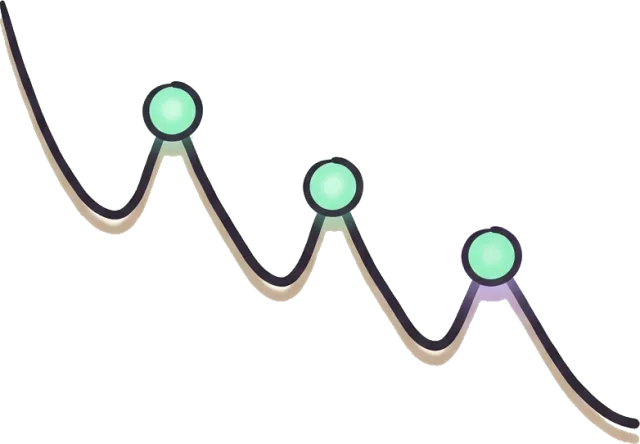
The forgetting curve may be the most shared chart in education. It shows up in textbooks, app ads and back-to-school slides, almost always with a dramatic number attached. It deserves better. Here is what Hermann Ebbinghaus actually measured, what recent research confirms, and what you can take from it for your own studying. For the practical side, our spaced repetition guide shows how a study app builds on this curve.
Who was Ebbinghaus, and what did he measure?
Hermann Ebbinghaus was a German psychologist. In 1885 he published Über das Gedächtnis (“On Memory”), translated into English in 1913. It describes a series of experiments with a single participant: himself.
His material was deliberately bare: nonsense syllables, built from a consonant, a vowel and a consonant. The point was to study memory without meaning, prior knowledge or associations getting in the way.
His method was subtler than most summaries suggest. Ebbinghaus learned a list until he could recite it without error, waited a set time, then learned it again. He measured the time saved on the second round compared with the first, which he called “savings”. If learning took 1,000 seconds the first time and 600 the second, the savings were 40 percent.
What does the curve show?
Ebbinghaus tested delays from twenty minutes to a month. His own summary (chapter 7, section 29 of the 1913 translation) comes down to this:
| Time since learning | What Ebbinghaus observed |
|---|---|
| About 20 minutes | He still saved about 58 percent of the original time |
| One hour | About half of the original work had to be redone |
| About 8 to 9 hours | About two thirds of the original work had to be redone |
| One day | Savings dropped to 33.7 percent |
| Six days | About a quarter of the effect remained |
| One month | About a fifth of the effect remained |
The shape is striking: a steep drop at first, then a slow decline. Memory loses far less between one day and one month than between twenty minutes and one hour. It is the shape, more than the exact numbers, that has lasted for well over a century.
Does the curve still hold today?
Yes. In 2015, Jaap Murre and Joeri Dros repeated the experiment as closely as possible (Murre and Dros, 2015, PLOS ONE 10(7), e0120644): one participant, about 70 hours of learning over 75 days, 70 lists of syllables, delays from 20 minutes to 31 days.
The results closely match Ebbinghaus’s. The authors noticed one detail: the curve is not perfectly smooth. It rises slightly from the 24-hour point, as if a night’s sleep consolidated part of what had been learned. They stay cautious about the cause. The sleep explanation fits a large body of research, summarized for example by Diekelmann and Born (2010), Nature Reviews Neuroscience 11(2), 114-126.
One more technical point: the curve fits a power law better than an exponential one. Forgetting slows down over time faster than an exponential model predicts (Wixted and Carpenter, 2007, Psychological Science 18(2), 133-134). That is the model the most recent spaced repetition schedulers use.
Do we really forget 70 percent of a lesson in 24 hours?
That number is everywhere, sometimes as 50 percent, sometimes 80. It does not survive a reading of the original, for three reasons.
- Savings are not the share remembered. Savings of 33.7 percent after a day do not mean 33.7 percent of the content is left. They mean relearning went about a third faster. Plenty of material can be “recoverable” without being recitable on the spot.
- Nonsense syllables are not a lesson. Ebbinghaus chose them precisely to remove meaning. A chapter you understand builds on what you already know, and his curves cannot tell you how fast you will forget it.
- One person, one kind of material. Both experiments involve a single participant. They describe a general shape, not a numerical law that applies to everyone.
What you can say without bending the research: without review, we lose a lot, and quickly. The shape of the curve is solid. The exact percentage depends on the material, the person and how it was learned.
How do you slow forgetting down?
Each time you retrieve something just as it was starting to fade, the next curve is flatter: forgetting takes longer. So you can wait longer before the following review.
Three habits follow from that:
- Review more than once. The next day, a few days later, a week later, a month later. That is spaced repetition, and we go through the evidence for its benefits study by study.
- Test yourself instead of rereading. Pulling an answer from memory strengthens it far more than reading the page again. This is the testing effect, measured by Roediger and Karpicke in 2006 and covered in our article on active recall.
- Sleep. Studying in the evening and then sleeping is not lost time. It is part of how memories are consolidated.
What does a month of reviews look like?
Take a history chapter covered in class on a Monday. Here is a simple calendar that follows the logic of the curve: close reviews at first, when forgetting is fastest, then wider and wider gaps.
| When | What you do | Rough time |
|---|---|---|
| Monday evening | Read once to understand, then write the main ideas from memory | 20 minutes |
| Tuesday | Answer questions on the chapter without looking at your notes | 10 minutes |
| Thursday | Same exercise; go back over what you missed on Tuesday | 10 minutes |
| The next Monday | Questions mixed with other chapters | 10 minutes |
| Two weeks later | Questions, then a blank page on the whole chapter | 15 minutes |
| A month later | Only the questions you missed, plus a few known ones to check | 5 to 10 minutes |
The total is barely over an hour, spread across a month. The same time spent in one block the night before a test would make the chapter feel more familiar, and let it fade a few days later. The durations are only a guide: a dense chapter needs more, one you already know needs less. What matters is that every pass makes you retrieve the material before you check it.
This calendar is fixed, and that is its weakness: it treats a date you remember effortlessly the same way as a date that slips away every time. That is exactly what a scheduling algorithm fixes.
How does a study app use the forgetting curve?
Spaced repetition schedulers model a personal forgetting curve for each card. They estimate how likely you are to recall the answer today and bring the card back when that likelihood drops below a threshold.
In Mindlet, that scheduler is FSRS-6. By default it aims for a 90 percent chance that you remember a card when you see it. It starts from average values, then adjusts its parameters every week based on your answers: a card you recall easily comes back less and less often, a card you struggle with comes back sooner. You add your course material and get AI-generated flashcards; the scheduling takes care of itself. Note that the Mindlet app itself is in French, while your cards can be generated in nine languages, including English.
Ebbinghaus measured what happens when you do not review. His curves also tell you when to come back to a lesson: early at first, then less and less often.
FAQ
Frequently asked questions
What is the forgetting curve?
It is a graph of how much of what you learned remains in memory as time passes. Hermann Ebbinghaus measured it in 1885: it drops steeply in the first hours, then levels off. Murre and Dros reproduced it in 2015, in PLOS ONE, with very similar results.
Do we forget 70 percent of what we learn within 24 hours?
Not in that form. The figure comes from a loose reading of Ebbinghaus, who measured how much time he saved when relearning lists of nonsense syllables, not how much of a lesson he kept. For meaningful material connected to what you already know, no study sets a universal percentage.
How can I beat the forgetting curve?
Review several times at growing intervals, and test yourself each time instead of rereading. Each successful recall slows the next round of forgetting, so the following review can wait longer. That is the principle of spaced repetition, which apps such as Mindlet schedule for you.
Does sleep affect forgetting?
Probably. The 2015 replication found a small upward bump in memory from the 24-hour mark, which the authors linked to sleep research without drawing a firm conclusion. A review by Diekelmann and Born (2010, Nature Reviews Neuroscience) summarizes the evidence that sleep helps consolidate memories.